















What W/m·K Actually Means for Potting
The number on the datasheet is true, and your part is still too hot. Both of those things can be true at once.
If you design electronics, you've probably done this: calculated how much heat the part needs to shed, called a material supplier, and gotten back a thermal interface material with a number on the datasheet. Three watts per meter-kelvin. Maybe six. Maybe you paid up for twelve.
You built a prototype. It worked. You specified the material and released the drawing.
Then, somewhere between the lab and the production floor, the part started running hotter than the model said it should.
Nobody lied to you. The material is exactly what the datasheet says it is. The problem is that the datasheet describes a material, and you're buying a joint. Those aren't the same thing, and the difference is where most thermal problems actually live.
What W/m·K Actually Tells You
Watts per meter-kelvin is a bulk material property. It says: take a perfect, uniform slab of this stuff, one meter thick, hold one side one degree hotter than the other, and this many watts will flow through each square meter.
That's the whole claim.
Notice what it doesn't say. Nothing about your part. Nothing about bond line thickness, how well the material wets the surfaces, whether there's a void in it, or whether the material coming out of your nozzle this morning is chemically the same as what went into the test fixture in the lab.
What you actually care about is K/W, thermal resistance: degrees of temperature rise per watt you're trying to remove. That number determines whether your junction runs at 85°C or 110°C, and it's the number the warranty depends on.
The relationship between them is:
$$\text{Thermal resistance} = \frac{\text{thickness}}{\text{conductivity} \times \text{area}} + \text{contact resistance}$$
Conductivity, the number you shopped on, is one term in the denominator. Thickness sits in the numerator, and it's set by your process, not your material choice.
| Thermal Metric | Definition & Scope | Key Variables & Process Influence |
|---|---|---|
| Bulk Conductivity ($W/m\cdot K$) | Thermal transport capacity of a uniform bulk slab | Supplier property; independent of geometry or joint thickness. |
| Thermal Resistance ($K/W$) | Degrees of temperature rise per watt removed | Dictates junction temp (85°C vs 110°C); highly dependent on thickness, wetting & voids. |
| Gap Fill Dynamics | Managing a thin joint between surfaces | Thinner bond line always beats higher bulk conductivity (3 W/m·K thin > 6 W/m·K thick). |
| Potting Dynamics | Filling an entire enclosed volume | No bond line to tighten; thermal path IS the material. Settling ruins performance. |
For gap fill or in-place gasketing, thickness shows up as bond line, and that leads to an uncomfortable fact: a 3 W/m·K material at half the bond line will outperform a 6 W/m·K material at double the bond line, every time. You can buy your way to a better number on paper and still lose the joint on the floor. Engineers who chase conductivity often get frustrated for exactly this reason. They doubled the spec, doubled the material cost, and moved the junction temperature four degrees. Conductivity wasn't the constraint. The process was.
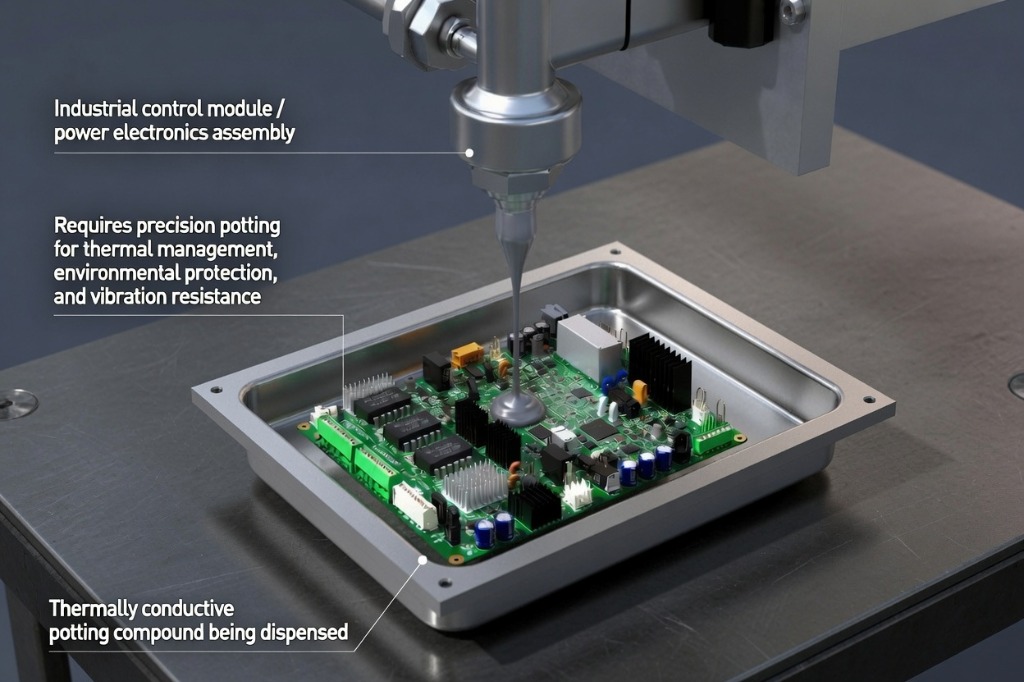
If you're potting, there's no bond line. You're not managing a joint, you're filling a volume, and the geometry is fixed by the enclosure. That sounds like it should make life simpler, and in one way it does: the process variable that hurts gap fill isn't available to hurt you.
But it also removes your last hiding place. In potting, the thermal path is the material. There's no bond line to tighten, no assembly pressure to tune, no fixture that recovers a few degrees. If the material underperforms, the part underperforms.
Which means the only question that matters is whether the material in your cavity is the material on the datasheet.
That turns out to be a harder question than it sounds.
The Part Nobody Mentions in a Design Review: the Lab Specimen Was Freshly Mixed
Here's the issue that actually keeps parts running hot.
Picture how that datasheet number was generated. A technician in a materials lab prepared a specimen. They mixed the material thoroughly, minutes before the test. Degassed it. Controlled the temperature. Pressed it into a fixture with a known, uniform bond line. Measured it.
That specimen was, by construction, a perfectly homogeneous sample of the certified formulation.
Now picture your production floor. That same material has been sitting in a five-gallon pail. It shipped on a truck, sat in receiving, sat in a stockroom, and has been on the line for three weeks, drawn down a little at a time.
Is what's in that pail still the certified formulation? Probably not, and here's why.
Why Filled Materials Come Apart in the Pail
A thermal interface material isn't a substance, it's a suspension: a polymer matrix carrying a large volume fraction of thermally conductive filler. Alumina, boron nitride, aluminum, ceramic. That filler is why the material conducts heat. The resin on its own is an insulator.
That filler is also heavy. Alumina has a specific gravity around 3.9. The resin carrying it is around 1.0. Dense particles suspended in a much lighter fluid, with gravity working on them since the day the pail was filled.
The rate they fall is described by Stokes' law:
$$\text{Settling velocity} \propto \frac{(\text{particle diameter})^2 \times (\text{density difference})}{\text{viscosity}}$$
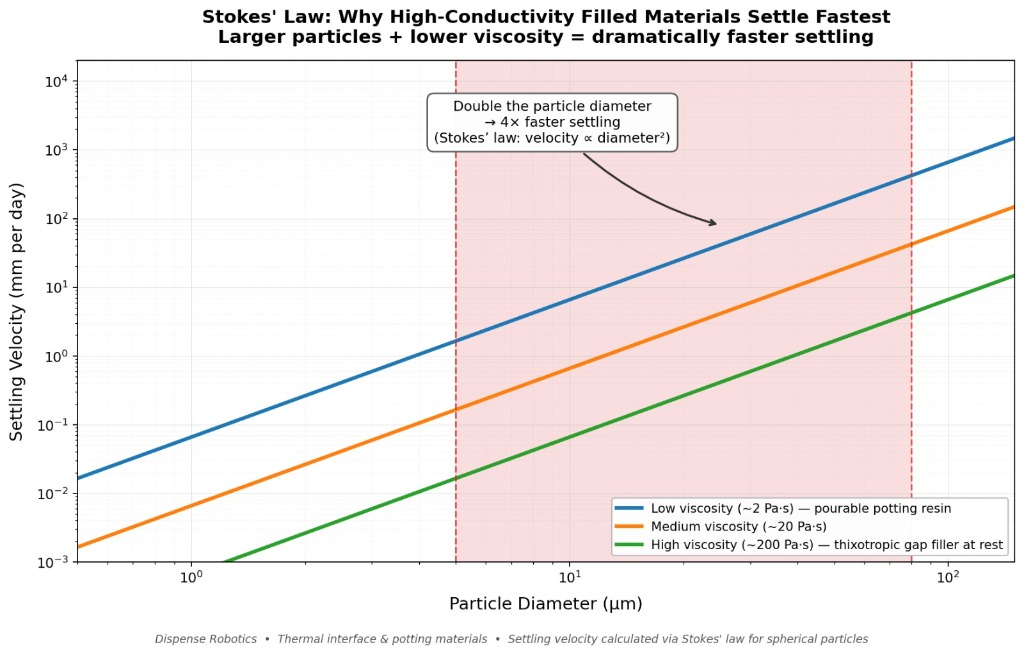 Caption: Settling velocity vs. particle diameter. The relationship is squared: double the particle size and the settling rate quadruples. High-conductivity formulations often use larger filler particles because they conduct better, which means the materials you paid the most for are frequently the ones most eager to come apart. The spread between the curves is viscosity — the same filler in a pourable potting resin drops out far faster than in a thixotropic gap filler.
| Stokes' Law Variable | Physical Parameter | Consequence for Potting Formulations |
|---|---|---|
| Particle Diameter ($d^2$) | Filler grain size | Squared term: doubling particle size quadruples settling rate. High-conductive TIMs use larger fillers, accelerating separation. |
| Density Difference ($\Delta\rho$) | Particle vs. Resin density | Heavy ceramic fillers ($\text{SG} \approx 3.9$) drop rapidly in lightweight resin matrices ($\text{SG} \approx 1.0$). |
| Viscosity ($\eta$) | Fluid flow resistance | Sits in denominator: low-viscosity potting resins let fillers drop out orders of magnitude faster than thixotropic gap fillers. |
Three things fall out of that, and none of them are good news:
- Bigger particles fall faster, much faster. It's a squared term: double the particle size and you quadruple the settling rate. High-conductivity formulations often use larger filler particles because they conduct better, which means the materials you paid the most for are frequently the ones most eager to come apart.
- Denser filler falls faster. That density difference is the engine, and it isn't going away.
- Viscosity sits in the denominator. This is the factor that matters most, and it explains why potting compounds settle so quickly compared to pastes.
Why This Hurts Potting Especially
If you're dispensing a high-viscosity gap filler, laying down a bead, forming a pad, running a CIPG gasket, you have a hidden advantage. That material is thick and often thixotropic. The matrix physically won't let the filler move far. Filler settling still happens, but it's slow, and the material's own body is protecting you.
Potting compounds don't get that protection. A pourable, self-leveling potting resin might be a few thousand centipoise, sometimes far less. It has to flow into every corner of an encapsulation, that's the whole point. The same low viscosity that lets it flow into corners is the low viscosity sitting in Stokes' denominator, letting the filler drop out of suspension.
Run the numbers directionally and it isn't subtle. Going from a stiff, thixotropic gap filler to a pourable potting compound doesn't make settling somewhat worse. It can make it worse by orders of magnitude.
If you pot, this is your problem, whether you've diagnosed it yet or not.
What Settling Actually Does to Your Part
Here's the insidious part, and the reason this goes undetected for years: it doesn't fail loudly.
When filler settles, the material stratifies. The bottom of the pail becomes filler-rich, dense and overloaded. The top becomes resin-rich, under-filled, thin, and thermally much worse than what you specified.
That resin-rich material still pumps and dispenses. It flows into the cavity fine, wets out beautifully (it's less filled, so it's easier to work with), and cures on schedule. It comes out looking exactly like a good part.
It just doesn't conduct heat.
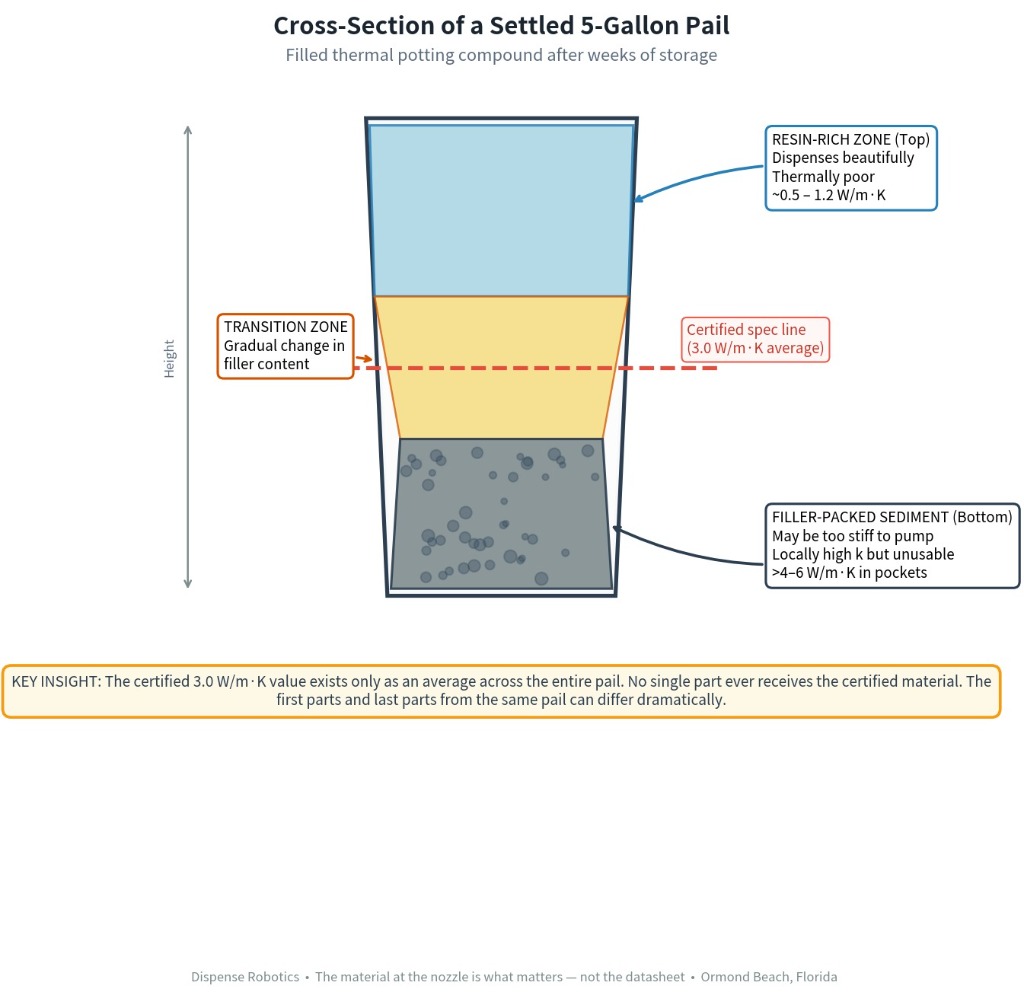 Caption: Cross-section of a settled pail (illustrative example, not measured data). The certified spec line falls through the middle of the container and through none of the actual material. The resin-rich zone at the top dispenses beautifully and conducts poorly. The certified value exists only as an average that no single part ever receives.
You've built a part that passes every visual and functional check you have and quietly runs ten or fifteen degrees hotter than your model predicted. You don't find out at the dispense station. You find out in thermal cycling, or qualification, or in the worst case, in the field eighteen months later, in a battery pack that shouldn't be at that temperature.
There's a second-order effect that's even harder to catch: the material drifts as you draw the pail down. The first parts out of a settled pail and the last parts out of it aren't made of the same material. Your process didn't change. Your material didn't change. Your pail changed, gradually, part by part.
Try finding that in a root cause analysis.
"But We Mix It"
Most people do something. Few do something that actually works, and several common approaches make things worse.
| Mixing Method | Intended Function | Failure Mode & Physical Reality |
|---|---|---|
| Drill & Blade | Manual agitation | Only mixes local channel; leaves packed bottom cake; introduces entrained air voids into potting resin. |
| High Shear / Speed | Fast sediment breakdown | Over-shear damages filler structure, generates unrated heat, and permanently alters formulation rheology. |
| Timer-Based Run | Fixed duration mixing | Blends to a habit rather than physical state; under-mixes aged pails or post-shutdown material. |
| Single-Axis Spinning | Pail rotation | Acts as a centrifuge; causes solid-body rotation with zero shear, driving heavy fillers outward against container walls. |
| Dual-Axis Gyroscopic | Zero-air homogenization | Rotates on two axes simultaneously, removing gravity floor; low-speed high-torque folding in sealed original pail. |
A drill and a paddle is the most common answer, and it has three problems. A blade only mixes where the blade goes, so you get a well-mixed channel and dead zones it never reaches, especially the packed cake against the bottom and the corners. Worse for potting, a blade whips air into the material, and every entrained bubble is a void. In a potting application a void isn't cosmetic, it's a thermal defect and a dielectric defect. You've introduced two failure modes trying to fix one. On top of that, the blade comes out covered in material and has to be cleaned, which is waste, labor, and a contamination vector.
Speed is the next instinct. When a cake won't break, people spin faster. With a heavily filled material, speed is the enemy. High shear can damage the material, generate heat it isn't rated for, and in some formulations permanently change its rheology. There's a ceiling, and for high-specific-gravity filled materials it's far lower than most people assume, often under 10 RPM, not hundreds.
Time on a timer is another habit. "Run it for twenty minutes." Where did twenty come from? Usually from someone who left the company. Twenty minutes may be plenty for a fresh pail and nowhere near enough for one that sat through a shutdown. You're not mixing to a state, you're mixing to a habit.
Simple rotation doesn't help either. A pail spinning about its own axis isn't a mixer, it's a centrifuge. Given time, the fluid reaches solid-body rotation, everything turning together, zero relative motion, zero shear, and the only thing still happening is heavy particles being driven outward and packed harder against the wall. Single-axis spinning doesn't just fail to mix. It actively de-mixes.
What Good Actually Looks Like
The physics tells you what you need, and it isn't complicated:
- The whole mass has to move, not just where a blade reaches. No dead zones, no packed cake left in the corner.
- "Down" has to keep moving. Dense particles settle because there's a fixed direction for them to settle toward. Continuously reorienting the container, rotating on two axes at once so it both tumbles end-over-end and spins, means the filler never gets a permanent floor to land on. The second axis doesn't add mixing energy. It takes away the settling direction.
- It has to happen slowly. Low speed, high torque. You're folding the material, not beating it.
- It should happen without a blade. Nothing entering the material means no entrained air, no cleanup, no contamination.
- It should happen in the container the material shipped in. Every transfer is a chance to introduce air, contamination, or loss.
- And it has to stop when the material is actually mixed, not when a timer expires.
That last point matters more than people expect. A packed cake resists motion, and you can feel it in the torque. As the cake breaks apart and disperses, that resistance falls and smooths out. The material is telling you what state it's in, if the machine is listening. Mixing to a measurement beats mixing to a timer, and it produces something a timer never can: a record.
The Question to Ask Before You Dispense a Drop
Here's the practical version of everything above. Before that material enters your dispensing system: do you know what the filler content is at the nozzle?
Not in the pail. Not on the datasheet. At the nozzle, in the material that's about to become the thermal path of a part you're going to ship.
If the answer is "we assume it's what the datasheet says," you're assuming your pail is still the certified formulation, and gravity has been arguing with that assumption for weeks.
Questions worth taking to your next design review:
- How long is the material in-house before it's dispensed? Through a shutdown? A holiday?
- What's the viscosity? There's no safe threshold — viscosity sets the timescale, not whether settling happens. A stiff material that sat through a shutdown is still stratified.
- What agitates the pail before it's loaded, and does it reach the bottom corners?
- Does anything keep the material moving during the run, or just before it?
- Is the material recirculated in the fluid path, or does it sit static in a hose between shots?
- Are you drawing from the top or the bottom of the container, and what does that mean for what you get first?
- How would you know if you were dispensing under-filled material right now?
That last one is the one to sit with. For most people, the honest answer is: you wouldn't, not until the part got hot.
The Disconnect
There's a gap in this industry worth naming plainly.
Material suppliers are excellent. They employ serious scientists, characterize their products carefully, and the numbers they publish are honest. But they characterize a material in a lab, on a properly prepared specimen.
Equipment suppliers are good at moving fluid: pressure, flow, shot size, repeatability.
Almost nobody owns the space in between, the question of whether the material that gets dispensed is still the material that was specified. It falls between two organizations, and so it falls on the floor, usually landing on a process engineer trying to explain a thermal failure with a dispense log that says everything ran perfectly.
Because everything did run perfectly. The machine dispensed exactly the volume it was told to, of exactly the wrong material.
What We Do About It
We build the complete fluid path, preparation through dispense, for the material you've already chosen. We don't sell material and we don't have a favorite. Our job is making sure the material your supplier certified is the material that reaches your part.
That starts before the pump. It starts at the pail.
If you're potting and you've got a thermal number you can't quite explain, we'd like to see your material. Not to sell you something, to measure it. Take a sample off the top of an aged pail and one off the bottom, and let's look at the filler content in each.
We think you'll find the conversation worth having.
Gavin Petersen has spent 30+ years in industrial fluid dispensing, including senior roles at Graco. He works with design and process engineers to trace thermal failures back to what's actually happening in the drum, not just what's on the datasheet.