

Dispensing Volume
Calculator
Calculate exact shot volume, required flow rate, and material consumption for dot and bead dispensing applications. Built for process engineers and equipment specifiers.
Volume Calculator
What Is Shot Volume in Precision Dispensing?
Shot volume is the precise quantity of fluid — measured in microlitres (µL) or cubic millimetres (mm³) — delivered by a dispensing system in a single activation cycle. For most precision manufacturing applications, controlling shot volume to within ±1–3% is critical for product quality, bond strength, and material cost management.
A convenient fact: 1 mm³ equals exactly 1 µL, which makes converting between geometry and fluid volume straightforward once you know your target dot diameter or bead dimensions from the design drawing. The calculation itself is simple geometry — what varies is which shape assumption best represents your actual dispense.
Shot volume directly determines which pump technology is appropriate for your process. Nano-scale dispensing below 10 µL requires fundamentally different hardware than high-volume beads measured in millilitres. It isn't simply a matter of scaling the same system — the underlying mechanisms differ.
How to Calculate Dispensing Volume
For a dot dispense, the most common approximation is a hemisphere, where the material wets out to a circular footprint and holds its shape. The volume is V = (2/3)πr³, where r is half the measured dot diameter. This works well for viscous materials like silicones and structural epoxies that resist spreading after deposition.
For a bead dispense, the cross-sectional profile determines which formula applies. A semi-circular bead — the standard for adhesive beads on flat substrates — gives V = (π/8) × w² × L, where w is the bead width and L is the bead length. A rectangular cross-section applies to dam-and-fill applications or dispensing into a groove or channel.
Real-world volumes deviate from these formulas based on material spread, substrate surface energy, and dispense speed. Always validate calculated values against measured dot or bead dimensions on the actual substrate before finalising pump parameters for production.
Dot vs. Bead Dispensing: Which Applies to Your Process?
The choice between dot and bead dispensing is determined by your assembly geometry, bond-line requirements, and motion platform capabilities. Understanding the distinction is the first step to specifying the correct system.
Dot Dispensing
Dot dispensing delivers a discrete, stationary shot at a fixed XY coordinate. The dispensing robot stops, dispenses, then moves to the next position. It is used for SMT adhesive attachment, underfill pre-dam deposition, solder paste, lubrication spots, and component bonding in electronics and medical device manufacturing. Shot time is typically 50–500 ms, and volumetric consistency per cycle is the primary performance metric.
Bead Dispensing
Bead dispensing traces a continuous line of material while the robot moves at constant speed. Volume per unit length (µL/mm) determines bead width, and maintaining consistent bead geometry requires closely matched robot velocity and pump flow rate. Bead dispensing is used for gasketing, sealing, conformal coating, thermal interface material application on EV battery cells, and structural adhesive bonds in automotive assembly.
Common Dispensing Applications by Industry
Precision dispensing equipment serves a wide range of high-technology manufacturing sectors. The table below summarises typical volume ranges and material types for each major application area.
⚡ EV Battery Manufacturing
Thermal interface materials applied as continuous beads across cell surfaces before heat-spreader assembly. Typical bead widths: 5–20 mm. Materials are high-viscosity (50,000–300,000 cP), requiring heated hose systems and progressive cavity or gear pump drives.
🔌 Electronics & PCB Assembly
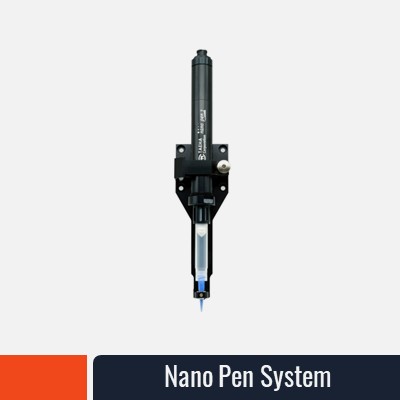
SMT adhesive dots, underfill dispensing, solder paste, and conformal coating. Dot volumes typically 1–50 µL with repeatability requirements below ±2%. Fast cycle times favour Nano Pen or PCP systems with high-speed controllers.
🚗 Automotive Assembly
Structural adhesives, sealants, and gasket materials applied as continuous beads for door panels, windscreen bonding, and powertrain sealing. Large bead cross-sections up to 100 mm². Two-component mixing capability is often required for structural epoxy systems.
Understanding Flow Rate and Pump Selection
Once you know the required shot volume and your target cycle rate, the minimum pump flow rate is their product: Flow Rate (mL/min) = Shot Volume (mL) × Shots per Minute. Most pumps should be operated at 60–80% of their rated maximum flow to maintain accuracy and extend rotor/stator life — so allow 25–40% headroom above your calculated minimum when selecting a pump model.
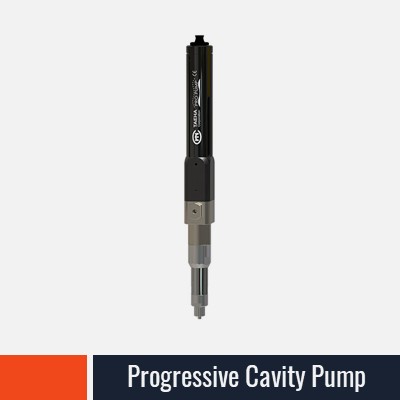
Progressive Cavity Pumps (PCPs) are the workhorses of precision volumetric dispensing. Their output is linear with rotational speed, which makes volumetric accuracy consistent across a wide viscosity range (1 cP to over 1,000,000 cP) without requiring pressure feedback or flow sensors. This linearity simplifies process setup and makes them particularly well suited to production environments where material viscosity varies with temperature or batch variation.
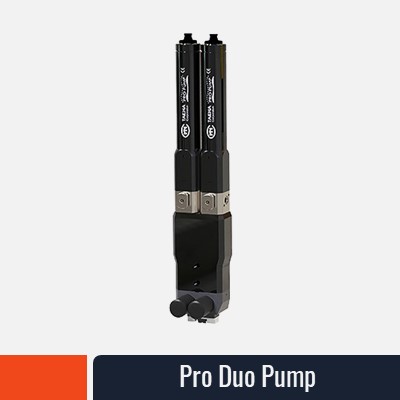
For two-component materials — epoxies, polyurethanes, silicone RTV systems — the Pro-Duo Pump (PDP) maintains the A:B mix ratio mechanically by coupling two metering pumps on a shared drive shaft. This eliminates the ratio drift that is common in pressure-fed 2K systems, where viscosity changes in one component can shift the delivered ratio without triggering an alarm.