









Why Filled Materials Destroy Standard Dispensing Pumps
If you dispense filled materials, you already know the failure pattern. The equipment works on day one. A few weeks in, shot weights start drifting. A few months in, you're rebuilding pumps and arguing with maintenance about why the "heavy-duty" system needs another rotor.
The reason is simple: a highly filled compound is liquid sandpaper. Alumina, ceramic, glass, silver — the fillers that give a material its thermal or electrical performance are hard particles suspended in a carrier, and every one of them grinds against your wetted parts at every shot. Standard stainless components wear, clearances open up, and output drops out of spec long before anything visibly breaks. You don't get a failure alarm. You get slow, silent drift — and scrap.
Two things make it worse: High filler loading means high viscosity, so the equipment runs under more load. And dense fillers settle in the container, so the material reaching the pump isn't even the material the datasheet describes.
Built for the Abrasion Instead of Pretending It Isn't There
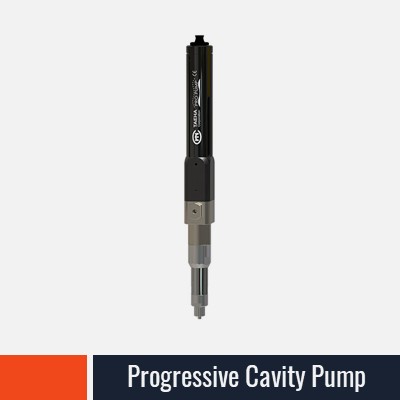
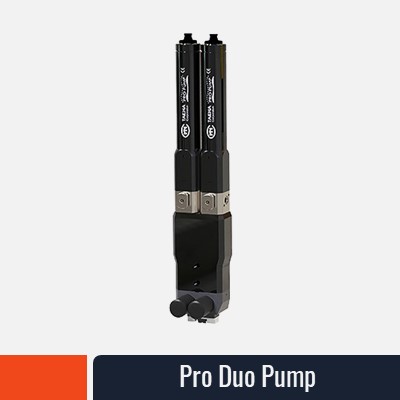
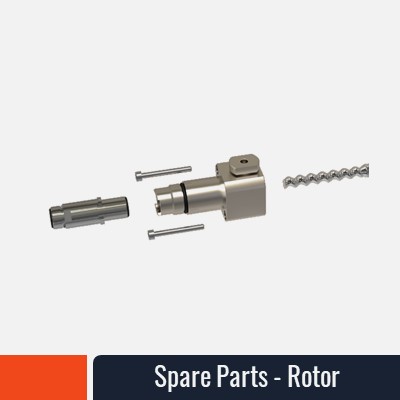
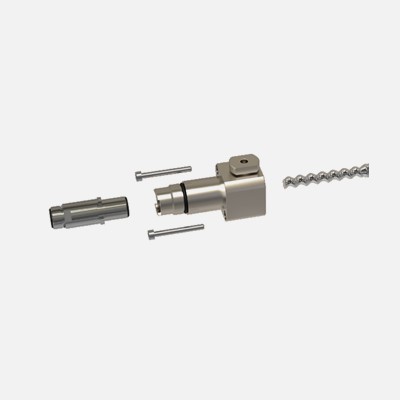
Tungsten Carbide Rotor
The rotor is the hardest-working part in a progressive cavity pump — so we make it out of tungsten carbide. It shrugs off particle abrasion that eats hard-chrome stainless, holding output over long runs.
Low-RPM Operation
Wear scales with speed. Because our progressive cavity design meters by cavity volume, it delivers accurate shots at 10 rpm or less for dense materials (SG > 2.0). Less speed, less wear, less shear.
Volumetric Metering
A progressive cavity pump moves sealed cavities of fixed volume. What goes in comes out, regardless of viscosity swings, temperature, or head pressure — eliminating drift.
Matched Elastomer Stator
Selected specifically for your fluid chemistry — FEPM as the workhorse for gap fillers, encapsulants, silicones, epoxies, and urethanes across a 0.9–3.5 specific gravity range.
System Specifications
| Specification | Detail |
|---|---|
| Wetted parts | Tungsten carbide rotor; FEPM stator (standard); alternative stator compounds per chemistry |
| Metering principle | Progressive cavity — positive displacement, volumetric |
| Viscosity range | 1 to 1,000,000 cP |
| Specific gravity range | 0.9 to 3.5 |
| Operating speed | Low-RPM; ≤10 rpm recommended for SG > 2.0 |
| Dispense modes | Dots, beads, continuous — no metering break required |
| Shot accuracy / repeatability | ±1% |
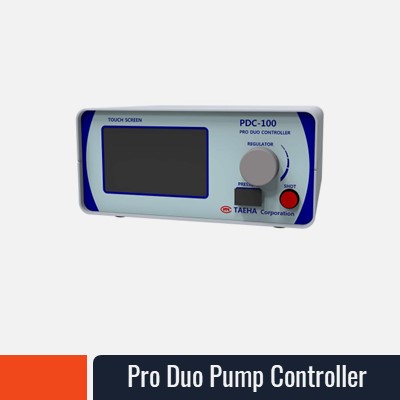
| 1K / 2K capability | Both — 2K with electronic ratio control |
Materials We Run
- Thermal gap fillers and thermal greases (alumina, boron nitride, zinc oxide filled)
- Ceramic-filled and glass-filled epoxies
- Silver-filled conductive adhesives
- Filled encapsulants and potting compounds
- Highly filled 2K silicones and urethanes
Solving Filler Settling in Container
Dense fillers settle in the pail during storage. Settled material means the compound entering the pump is filler-lean at the top and filler-rich at the bottom — causing shot performance to vary even with perfect volume control.
We pair our pumps with a gyroscopic mixer that re-homogenizes the material directly inside its original sealed container. No air entrainment, no transfer step, and no property degradation. See the StokesIt 360 & 400 mixers →
Key Engineering Benefits
Wear parts that last
Tungsten carbide holds its geometry against particle abrasion — fewer rebuilds, dramatically lower maintenance downtime, and no slow output drift between service cycles.
Accuracy that doesn't decay
Volumetric metering paired with abrasion-resistant parts means shot weight on the thousandth shift matches the exact tolerance of shot number one.
Gentler on the material
Low-RPM progressive cavity design maintains low shear. Filled compounds are expensive; avoiding particle shearing and friction heating protects the material properties you paid for.
One system across the range
From water-thin resins to high-viscosity pastes, 1K or 2K, the same metering principle applies — sized precisely with pump displacements from 0.005 to 50 ml/rev.
Proven Durability on Highly Filled Gap Filler Lines
Manufacturing plants switching from stainless steel gear and piston pumps to our tungsten carbide progressive cavity systems have eliminated chronic output drift and reduced rebuild frequency by over 70% on 2.5–3.2 W/m·K abrasive gap filler lines.
Experience Behind the Engineering
Gavin Petersen has spent 30+ years in industrial fluid dispensing, including senior roles at Graco. Abrasive filled compounds are the problem he's been asked to solve most often — the tungsten carbide, low-RPM approach is what three decades of worn-out rotors points to.
Learn more about our experience