









The Physics Doesn't Read the Production Schedule
Filled thermal and structural materials get their performance from dense filler suspended in a carrier built to flow. Stokes' law sets the rate the filler falls: it rises with particle size and the density gap to the carrier, and falls with carrier viscosity. Every term works against a highly filled material.
A few weeks on the shelf and the pail is stratified — filler-rich at the bottom, thin and thermally poor at the top, a consolidated cake underneath. Nobody did anything wrong. The supplier's number is honest, the pump did what it was told, the spec was right. The law was operating the whole time.
Every filled-material technical data sheet says some version of "agitate before use." The question StokesIt answers is whether your method of agitation actually restores the certificate-of-analysis loading — without creating a different problem.
Restore the Loading Without Opening the Pail
Sealed Pail, No Blades
The container never opens. No shaft, no paddle, no entrained air, no cleanup — the material that goes in is the material that comes out.
Two Axes, Load Upright
Quart to five-gallon pails load vertically and clamp automatically. Two-axis rotation re-orients the whole volume, not just the surface.
Cycle Set From Physics
Stokes' law run in reverse: from particle size, carrier viscosity, filler density, and shelf time, we give you a time-and-speed recipe instead of a guess.
Restore, Then Hold
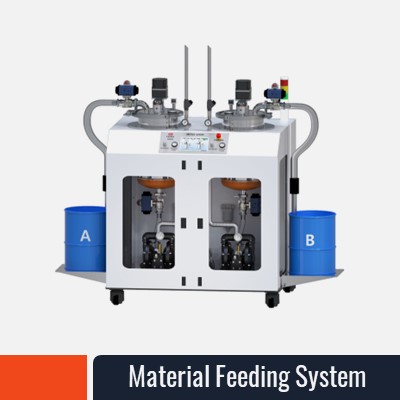
StokesIt brings the pail back to the CoA. Pair with a Dispense Robotics MFS vacuum feed system to hold it there under vacuum for the life of the pail.
StokesIt 360 & StokesIt 400

StokesIt 360
Quart to 5-gallon · up to 79 lb · compact footprint. Fixed 1-minute cycle, one-button start.

StokesIt 400
Quart to 5-gallon and tall pails to 19.5 in · up to 105 lb · programmable cycle (10–900 s).
System Specifications
| Specification | StokesIt 360 | StokesIt 400 |
|---|---|---|
| Mixing action | Gyroscopic, two-axis; pail loaded upright | Gyroscopic, two-axis; pail loaded upright |
| Container size | Pint to 5 gallon | Pint to 5 gallon, including tall pails |
| Container envelope, min / max | 2 × 2.75 in / 15.75 × 16.5 in (dia × height) | 2 × 2.75 in / 15.75 × 19.5 in (dia × height) |
| Maximum container weight | 79 lb (36 kg) | 105 lb (48 kg) |
| Clamping | Automatic; pressure set by container height | Automatic; pressure set by container height |
| Mixing speed | 150 / 220 / 240 rpm, auto-selected | 150 / 185 / 240 rpm, auto-selected |
| Cycle time | Fixed 1-minute cycle | 10–900 s, programmable in 10 s steps |
| Operation | One-button start; tray auto-unlocks and slides out | One-button start; tray auto-unlocks and slides out |
| Return position | Container returned upright to load position | Container returned upright to load position |
| Power | 750 W, 110 V 60 Hz | 1,500 W, 120 V 60 Hz |
| Machine dimensions, W × D × H | 34 × 36 × 42 in (864 × 914 × 1,067 mm) | 39 × 37 × 47 in (991 × 940 × 1,194 mm) |
| Net weight | 541 lb (245 kg) | 589 lb (267 kg) |
| Safety | Interlocked doors, emergency stop | Interlocked doors, emergency stop |
Where It Earns Its Keep
- TIMs and gap fillers above S.G. ~1.5 or 50% filler by weight
- Silver-filled and high-conductivity compounds
- Potting and encapsulation resins
- Any line with first-shot variation after a break
Your Supplier Already Told You to Do This
Every filled-material TDS says "agitate before use." The question is whether your method restores the CoA loading without creating a new problem.
Drill mixing entrains air, shears unevenly, has no endpoint, and leaves the cake. Tumbling the sealed pail does none of that.
Key Engineering Benefits
No contamination path
No shaft, paddle, or open lid means no ingress point for moisture or contamination — important for moisture-cure chemistries and materials with a documented open-shelf life.
A calculated cycle, not a guess
Stokes' law run in reverse turns "agitate thoroughly" on the TDS into an actual time-and-speed number, specific to your material and shelf time.
One-button, low-touch operation
Automatic clamping sized to container height, one-button start, and an auto-unlocking tray — no operator judgment call on when the material "looks mixed."
Pairs with vacuum feed
StokesIt restores the spec; a Dispense Robotics MFS vacuum feed system holds it there under continuous vacuum for the life of the pail.
Supplied and Supported From Ormond Beach, Florida
Installation, material recipes, and spares from US stock. Long-settled pails get a one-minute pre-step — break the cake with a paint stick before loading. Specifications subject to change without notice.
Experience Behind the Engineering
Gavin Petersen has spent 30+ years in industrial fluid dispensing, including senior roles at Graco. Filler settling is one of the most common and least diagnosed problems he sees on production floors — StokesIt is built around restoring the material to what its own datasheet promised.
Learn more about our experience