

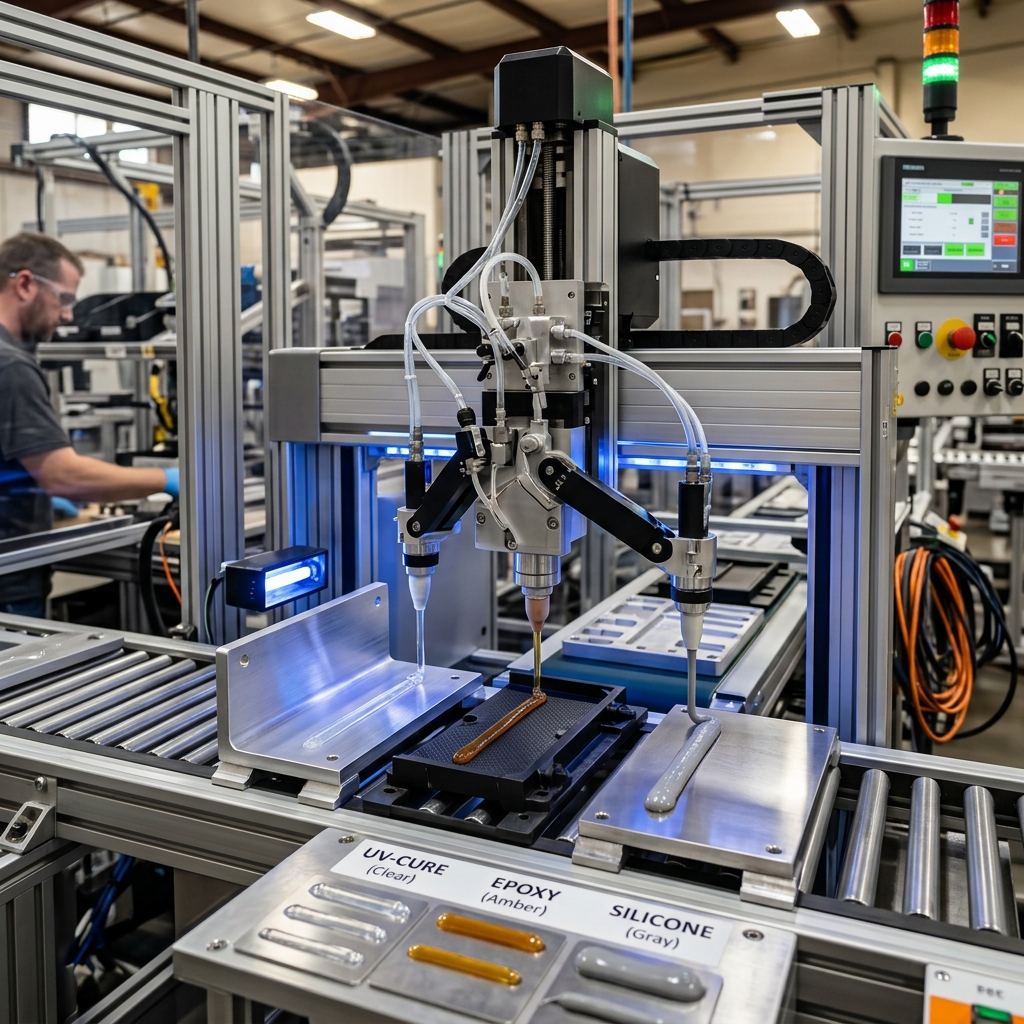
Epoxy, 2K Urethane, Silicone, UV, MMA, or Cyanoacrylate: How to Choose the Right Adhesive Chemistry
Introduction
Epoxies, two-part urethanes, silicones, UV-cure materials, methyl methacrylates (MMAs), and cyanoacrylates are the core chemistries used in precision manufacturing for structural bonding, tacking, and potting. You see them in electronics assembly, EV battery and power electronics work, medical devices, automotive modules, aerospace components, and composite structures.
These materials behave very differently. A rigid epoxy that works on steel may crack on aluminum-to-plastic joints under thermal cycling. A fast UV material or cyanoacrylate can transform production speed — but only if it matches the substrates, gap geometry, and stresses. A flexible 2K urethane is often more cost-effective than an epoxy while delivering the toughness you actually need.
In 30+ years running these materials through dispensing equipment in production environments, the pattern I see repeatedly is teams choosing chemistry based on a single performance number — usually tensile strength — while ignoring the service environment, substrate compatibility, and whether the production process can actually apply it consistently.
This guide gives you a clear framework, a six-way comparison matrix, and practical dispensing notes for each chemistry.
First: Adhesives vs. Sealants (and Why the Distinction Matters)
An adhesive is designed primarily to hold parts together with measurable strength — shear, peel, or tensile. Structural adhesives like epoxies, MMAs, and cyanoacrylates fall here.
A sealant is designed primarily to block fluids, gases, or contaminants. It typically has high elongation and lower strength than a structural adhesive.
Many modern products are adhesive-sealants — silicones often sit here, providing genuine bonding capability alongside flexible sealing. Two-part urethanes and some epoxies can be formulated as hybrids.
When your application needs both strength and sealing, don't choose on strength data alone. Review elongation, flexibility, and weathering data. A product optimised purely for structural strength will crack under cyclic movement. One optimised purely as a sealant won't hold the joint under load.
Quick Lesson on Durometer — Why Hardness Determines What Survives
Durometer measures how hard or soft the cured adhesive is. This single property is responsible for more bond failures than almost anything else.
Shore A scale — soft, rubbery materials. 30A is very flexible; 80–90A is firm but still flexible. Most silicones and flexible 2K urethanes fall in the 30A–70A range.
Shore D scale — rigid, plastic-like materials. 50D–90D. Rigid epoxies and most MMAs sit here.
Why it matters: Higher durometer resists deformation and handles higher static loads but tolerates almost no differential movement between bonded parts. Lower durometer absorbs CTE mismatch, vibration, and impact far better but delivers lower peak strength.
The rule:
- Rigid joint, high static load, minimal movement → higher durometer (rigid epoxy or MMA)
- Vibration, thermal cycling between dissimilar materials, or need for joint flexibility → lower durometer (silicone, flexible 2K urethane, or toughened/flexibilized epoxy)
A rigid epoxy bonding two steel plates with no movement is correct. The same epoxy bonding an aluminum heat sink to a plastic housing — where thermal cycling generates repeated stress at the bond line — is a crack waiting to happen.
Substrate Compatibility at a Glance
| Substrate | Best Chemistry Options | Notes |
|---|---|---|
| Steel | 2K Epoxy, MMA, 2K Urethane, Cyanoacrylate | Clean and lightly abrade. All bond well on non-porous steel. |
| Aluminum | 2K Epoxy, MMA, 2K Urethane, Cyanoacrylate | Same as steel. For dissimilar joints to plastic, use toughened/flexible grades. |
| Glass | UV-cure, 2K Epoxy, Silicone, Cyanoacrylate | UV excellent for transparent bonds. Silicone for sealing + bonding. CA wicks neatly into glass joints. |
| Ceramics | 2K Epoxy, UV-cure, Cyanoacrylate | Surface cleanliness critical. |
| Carbon fibre / fiberglass composites | MMA, Toughened Epoxy, 2K Urethane | MMAs tolerate slightly less surface prep. CA typically for tacking only. |
| Engineering plastics (ABS, PC, nylon) | MMA, 2K Epoxy, 2K Urethane, Cyanoacrylate | Verify with specific plastic. CA works on many non-porous engineering plastics. |
| Low-surface-energy plastics (PE, PP) | Any — with primer or surface treatment | Without correct treatment, standard adhesives fail regardless of chemistry. |
| Dissimilar materials (metal + plastic, metal + glass) | 2K Urethane, Toughened Epoxy, MMA | Flexibility to absorb CTE mismatch is essential. Rigid epoxy or basic CA will crack. |
The Six-Chemistry Comparison Matrix
| Chemistry | Primary Role | Strength | Flexibility (Durometer) | Max Continuous Temp | Cure Speed | Key Advantages | Key Limitations | Relative Cost |
|---|---|---|---|---|---|---|---|---|
| 2K Epoxy | Structural adhesive / potting | High | Rigid to toughened (50D–90D) | 120–180 °C (special grades higher) | Room temp (slow) or heat cure | Strength, chemical resistance, gap filling, formulation versatility | Can crack without toughening; mix ratio critical; abrasive filled versions wear equipment | Medium–High |
| 2K Urethane | Structural / flexible adhesive | Medium–High | Flexible to semi-rigid (40A–80D) | ~100–120 °C | Room temp; minutes to ~1 hr | Toughness + flexibility, good on plastics/composites, often lower cost than epoxy | Moisture sensitive during cure (foaming); lower max temp and chemical resistance than epoxy | Lower–Medium |
| Silicone (RTV or 2K) | Flexible adhesive-sealant | Low–Medium | Very flexible (20A–70A) | 150–200 °C+ | 1K: slow (moisture); 2K: faster | Extreme temp flexibility, excellent sealing and weathering, stays rubbery | Lower strength; 1K cure is slow; often needs primer for best adhesion | Medium |
| UV-Cure (acrylic, epoxy, or silicone base) | Fast adhesive / potting / tacking | Medium–High | Rigid to flexible (varies by formulation) | Varies by base chemistry | Seconds under UV/visible light | Near-instant fixture, ideal for high-speed automated lines, precise control | Requires line-of-sight light access; shadow areas need secondary cure mechanism | Medium–High |
| 2K MMA (Methyl Methacrylate) | Structural adhesive | High | Toughened / semi-flexible (40D–80D) | ~100–120 °C | Fast room-temp cure (minutes) | Fast structural strength, excellent toughness and impact resistance, tolerates lighter surface prep | Strong odor during cure; temperature sensitive; mix ratio critical | Medium |
| Cyanoacrylate (CA) | Instant adhesive / tacking / small-part bonding | Medium | Low / brittle (rigid) — toughened grades available | Typically up to 80–100 °C | 1K moisture-activated (seconds to minutes) | Extremely fast cure, no mixing required, excellent wicking into tight spaces, bonds many non-porous materials quickly | Brittle in standard versions; poor gap filling; blooming (white residue); lower peel and impact strength; humidity sensitive | Low–Medium |
Dispensing Considerations by Chemistry
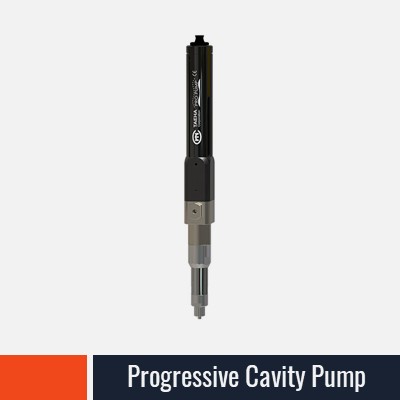
2K systems (epoxy, urethane, MMA): Accurate metering and mixing is not optional — off-ratio results in weak spots, soft areas, or incomplete cure. Use reliable meter-mix-dispense equipment with static or dynamic mixers. For filled or abrasive epoxies (thermally conductive grades), progressive cavity pumps with carbide rotors are the right call — gear pumps and auger valves wear rapidly with alumina-filled materials.
UV-cure materials: Low-to-medium viscosity makes them well-suited for jetting, needle, or valve dispensing. UV lamp integration into the process line is essential — cure on the fly rather than as a separate step.
Cyanoacrylates: 1K, no mixing required — the simplest dispensing scenario. Low-viscosity versions wick into tight gaps under capillary action; gel versions stay in place on vertical surfaces for more controlled placement. Precision dispensing is still worth having to control bead size and avoid excess material that causes blooming (the white haze around the joint). Activator sprays or primers can be used to accelerate cure on difficult substrates.
High-viscosity silicones: Often thixotropic. Formed-in-place gasket applications benefit from consistent bead width and height — a dispensing robot holding a fixed standoff height gives you that consistency at scale.
Vacuum-assisted potting: For void-free electronics encapsulation — especially silicones and low-viscosity epoxies — vacuum degassing before or during dispensing removes entrained air that becomes thermal hot spots or partial discharge sites in high-voltage applications.
Common Failures and What Causes Them
Selecting a rigid high-durometer epoxy for a joint that will see vibration or CTE mismatch between dissimilar materials. Cracking at the bond line edge is the result — predictable from the start.
Inaccurate mix ratio on any 2K system. The most common single cause of adhesive bond failures in production. The fix is metering equipment, not process vigilance.
Incomplete UV cure in shadowed areas. Uncured adhesive in shadow zones needs a secondary cure mechanism built into the process, not added after the first failure report.
Allowing moisture contamination during 2K urethane application and cure. Foaming is visible; weakened adhesion often isn't.
Cyanoacrylate blooming on visible surfaces. Usually caused by excess material, high ambient humidity, or too much activator. Control bead size and ventilate the work area.
Skipping surface preparation on low-surface-energy plastics because "it was fine last time."
Quick Decision Guide
Maximum strength, chemical resistance, and gap-filling with flexibility as an option → 2K Epoxy (toughened/flexibilized grades when movement is expected).
Balance of strength and flexibility, often lower cost, especially on plastics or composites → 2K Urethane.
Extreme temperature capability while remaining flexible, plus sealing performance → Silicone (RTV or 2K).
High-speed automated production with line-of-sight access to the bond line → UV-cure material.
Fast structural strength on metals and composites with excellent toughness and impact resistance → 2K MMA.
Extremely fast tacking or bonding of small parts on non-porous surfaces with minimal gap → Cyanoacrylate (toughened grades for better impact resistance).
Bringing It Together
Once the chemistry is selected, consistent dispensing is what turns a lab result into a reliable production process. Precise metering, mixing, bead placement, and process control make the difference between an adhesive that works in a test and one that holds up across thousands of production cycles.
Once you've identified the right chemistry, work through the 5-step adhesive selection framework to validate substrate compatibility, environment, and process fit before you commit.
The dispensing system matters too — see how to choose adhesive dispensing equipment for system selection based on your material and volume.
If you're evaluating options for a current application — electronics potting, composite-to-metal structural bonding, high-temperature flexible sealing, fast-cycle automated assembly, or small-part cyanoacrylate bonding at volume — the pump configurator is a useful starting point for understanding your dispensing requirements, or contact us to discuss the specific material and process.
Gavin Petersen has spent 30+ years in industrial fluid dispensing, including senior roles at Graco. He works directly with manufacturing engineers to match dispensing equipment and process parameters to the chemistry and application requirements of real production environments.