

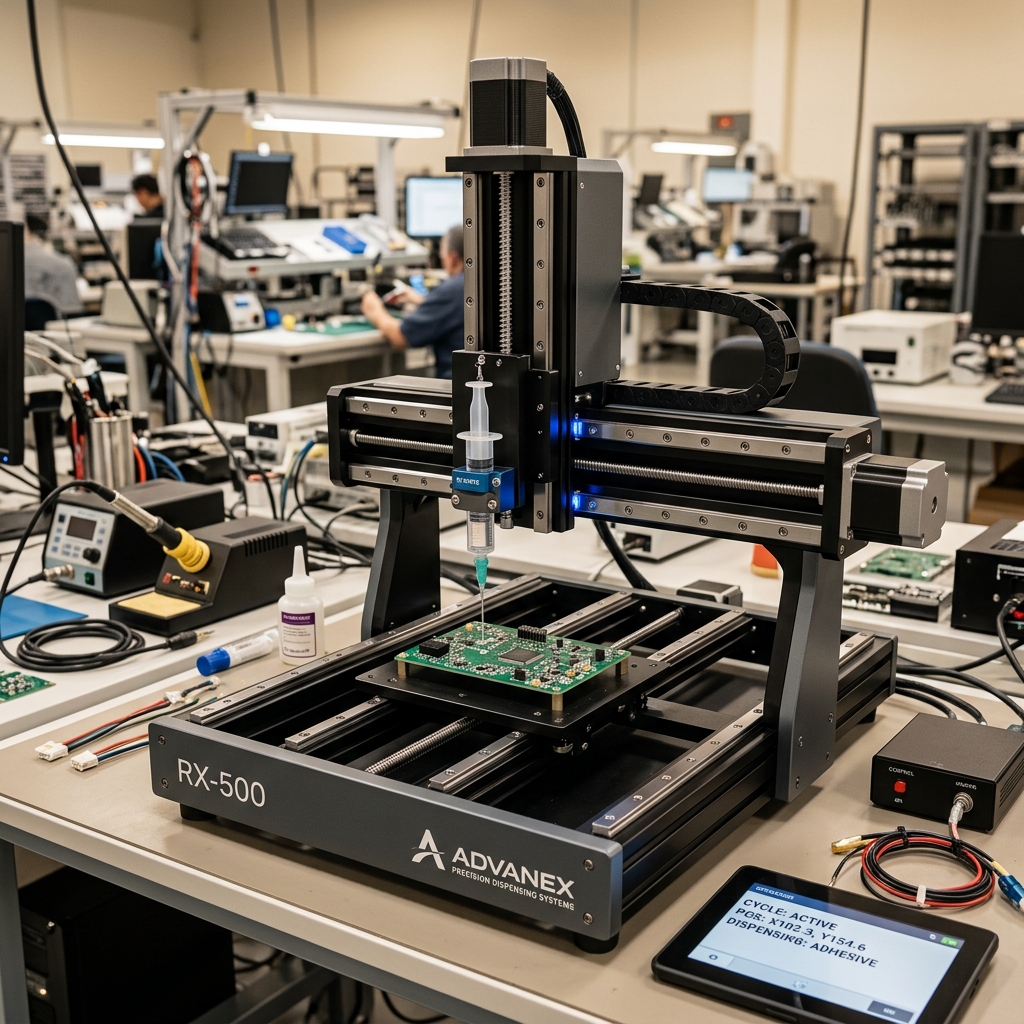
Desktop Dispensing Robots: When a Floor Robot Is the Wrong Answer
Introduction
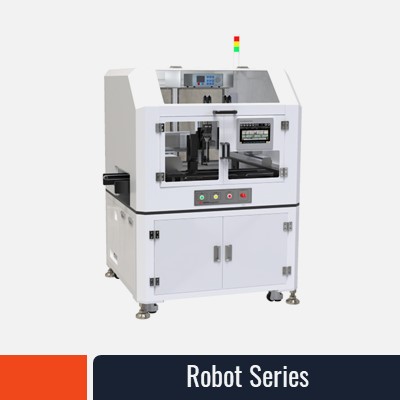
Floor-standing dispensing robots are the default assumption when engineers start thinking about automating adhesive or sealant application. They're the reference point — big gantry, full enclosure, high throughput.
They're also overkill for a significant portion of dispensing applications.
If you are dispensing on small PCBs, prototyping a new adhesive process, running low-volume high-mix production, or qualifying a bond joint design before committing to full-scale automation, a floor robot costs more capital, takes more floor space, and requires more integration work than the application justifies.
A desktop dispensing robot is purpose-built for that gap.
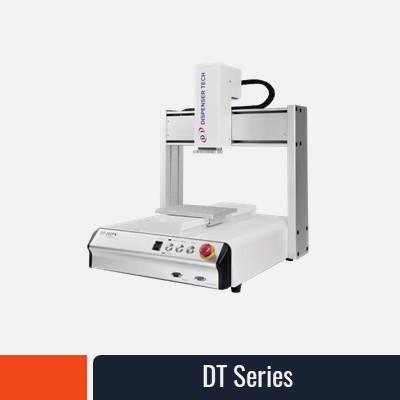
A desktop dispensing robot is a compact XYZ gantry platform — typically covering a 200–400 mm work envelope — designed for precision fluid dispensing on a standard workbench. It uses the same valves, pumps, and dispensing mechanics as floor-standing production systems, at a fraction of the footprint and capital cost.
What a Desktop Dispensing Robot Actually Is
A desktop dispensing robot — sometimes called a benchtop or tabletop dispensing robot — is a compact XYZ gantry platform sized to sit on a workbench rather than occupy a machine cell. The XYZ axes move a dispensing head (valve, pump, or needle) through a programmed path over the part below.
The mechanics are identical to a floor robot: servo or stepper-driven axes, programmable dispensing sequences, teach-pendant or software-based path programming, and compatibility with the same range of dispensing valves and pumps you would use on a production floor system.
The difference is form factor and scale. A desktop robot typically covers a work envelope in the range of 200–400 mm per axis — sufficient for PCBs, small assemblies, connectors, filters, and similar components. It sits on a standard workbench, requires no special anchoring, and in most cases can be moved between workstations.
Applications Where Desktop Robots Are the Right Tool
Electronics assembly — small and medium PCBs. Underfill, conformal coating, SMT solder paste dispensing, and adhesive bonding on PCBs are natural desktop robot applications. The part size fits the work envelope, cycle times are manageable for the throughput, and the precision required (often ±0.1 mm or better) is exactly what a servo-driven gantry delivers.
R&D and process development. When your engineering team is validating a new adhesive, qualifying a dispensing process, or developing bond joint specifications, they need a real robot — not a hand applicator that can't hold a consistent path, and not a full production cell that ties up capital while parameters are still being iterated. A desktop robot gives the engineering team a qualification platform with the same dispensing mechanics as the eventual production system. A common failure mode: process parameters get signed off on a hand-applied bead, then the production floor robot can't reproduce them because the path speed, corner deceleration, and suck-back timing were never controlled. The desktop robot eliminates that gap — what you qualify is what the floor robot runs.
Low-volume and high-mix production. Contract manufacturers and OEMs building premium, low-volume products — medical devices, aerospace components, custom electronics — often have too many SKUs and too low a volume per SKU to justify the cycle time optimisation needed on a floor robot. A desktop robot handles the mix without the overhead.
Clean room and laboratory environments. Desktop robots have a smaller physical footprint and lower particulate generation footprint than floor systems. Where clean room square footage is expensive and production volumes are modest, a desktop robot is the appropriate scale.
Incoming or outgoing QC dispensing. Some manufacturers need precise adhesive or sealant application for test fixture assembly, potting of test samples, or small-batch production of calibration components. A floor robot is not the right tool for this; a desktop robot is.
What Separates a Dispensing Robot From a Generic XYZ Platform
There is a meaningful difference between a generic XYZ automation platform and a purpose-built dispensing robot.
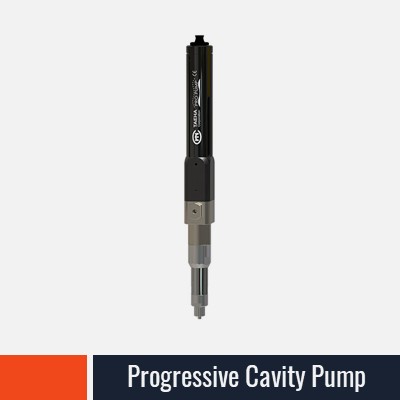
A dispensing robot is designed around the specific demands of fluid application: the ability to synchronise axis motion with dispensing output (so bead width stays consistent through corners and speed changes), compatibility with a range of valve types (needle valve, progressive cavity pump, 2K mixing head, syringe), and dispensing-specific programming — setting start and end points, controlling purge sequences, and adjusting suck-back at shot end.
A generic XYZ platform can physically move a syringe. A dispensing robot controls the entire fluid application sequence — motion, timing, volume, and the start/stop behaviour at each deposit.
For precision applications, the distinction matters. A consistent bead requires consistent motion AND consistent dispensing output through every segment of the path, including acceleration and deceleration zones.
When to Choose Desktop vs Floor Robot
The decision is straightforward when you map it to your actual requirements:
Choose a desktop dispensing robot when:
- Part size fits within a 400 mm work envelope
- Throughput requirement is under 20–30 cycles per hour (application-dependent)
- You are in R&D, process validation, or early-stage production
- Floor space is constrained
- Capital budget is more limited, or the application doesn't justify full production-cell investment
- You need a self-contained, portable system that can be redeployed
Move to a floor-standing system when:
- Production volume demands continuous high-cycle operation
- Parts require a larger work envelope
- Integration with upstream/downstream automation (conveyors, vision, handling robots) is required
- You need full enclosure for fume extraction or safety compliance
Many facilities run both: a desktop robot in engineering for process development and qualification, floor robots in production once parameters are locked. The desktop robot pays for itself in the time it saves the floor production system from being used as a development platform.
Frequently Asked Questions
What is a desktop dispensing robot?
A desktop dispensing robot is a compact XYZ gantry platform designed for precision fluid dispensing — adhesives, sealants, potting compounds, conformal coatings — in applications where a floor-standing production robot is too large or too costly. It sits on a standard workbench, covers a small-to-medium work envelope (typically 200–400 mm per axis), and uses the same dispensing valves and pumps as full production systems. Common uses include electronics PCB assembly, R&D process development, low-volume high-mix production, and clean room or laboratory applications.
What is the difference between a desktop and a benchtop dispensing robot?
The terms are used interchangeably in industrial dispensing. Both refer to compact, table-mounted XYZ dispensing systems designed for small work envelopes and lower throughput than floor-standing production robots. "Benchtop" is slightly more common in laboratory and R&D contexts; "desktop" is used more often in production contexts. Neither term implies a specific technical difference — both describe the same class of machine.
What materials can a desktop dispensing robot apply?
A desktop dispensing robot is compatible with the same material range as floor-standing systems, determined by the dispensing valve or pump installed. With a needle valve or time-pressure system, it handles low-to-medium viscosity materials — fluxes and thin adhesives from 1–500 cP up to filled coatings in the 5,000–20,000 cP range. With a progressive cavity pump, it handles high-viscosity pastes and thermal interface materials from 50,000 cP to over 1,000,000 cP. With a 2K mixing head, it handles two-component epoxies and polyurethanes. The robot platform itself is material-agnostic — the dispensing head attached to it defines the material capability.
What accuracy should I expect from a desktop dispensing robot?
Purpose-built desktop dispensing robots achieve positional repeatability in the ±0.01–0.05 mm range depending on design and axis drive system. For most electronics and medical device applications, ±0.1 mm or better is achievable. Bead width and deposit volume accuracy depend on the dispensing valve or pump selected — the robot's positional accuracy and the dispense system's volumetric accuracy work together. For applications with tight bond joint specifications, pairing a servo-driven gantry with a positive displacement pump (progressive cavity pump) gives the best combined accuracy.
The Bottom Line
Floor robots are not the right answer for every dispensing application. When the part is small, the volume is low, or the process is still in development, a desktop dispensing robot delivers the same dispensing precision in a fraction of the footprint — without the capital investment or integration complexity of a production-scale system.
If your process development team is hand-applying adhesive to small assemblies, or your low-volume line is hand-loading a floor robot that's mostly waiting between cycles, a desktop robot is likely the correct tool.
Explore the Dispense Robotics DT Series desktop dispensing robots or contact us to size the right platform for your part and application.
Gavin Petersen has 30+ years in industrial fluid dispensing, including senior roles at Graco. He works directly with manufacturing engineers to select dispensing automation matched to their process requirements.