

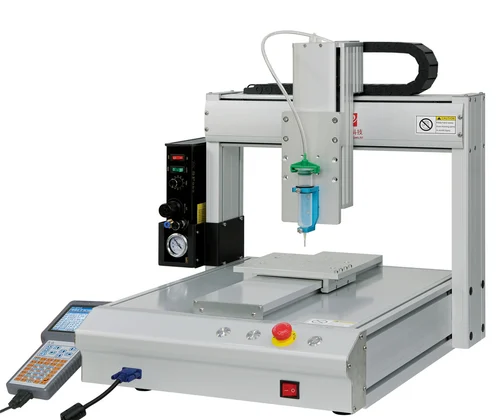
Adhesive Dispensing Robot: Complete Guide for Manufacturers
Introduction
Manufacturing today demands speed without sacrificing precision. Adhesive dispensing robots automate the application of adhesives with repeatable accuracy that manual processes simply cannot match. Whether you're bonding components in PCB assembly, sealing EV battery packs, or assembling medical devices, an adhesive dispensing robot transforms your production line by eliminating human variability and material waste.
These systems apply epoxy, cyanoacrylate, silicone, UV adhesive, and other materials in microdots, continuous beads, or spray patterns—all controlled by programmable logic and feedback sensors. For manufacturers juggling tight tolerances and high-volume demands, adhesive dispensing robots are no longer optional. They're the standard for competitive production.
What Is an Adhesive Dispensing Robot?
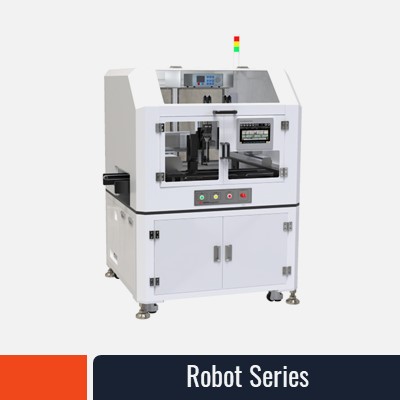
An adhesive dispensing robot is a computerized system that applies adhesives to components with sub-millimeter precision. It combines three core elements: a robotic arm (often with 4, 5, or 6 axes of movement), a precision dispensing valve or pump, and a control system that manages flow, timing, and positioning.
The robot arm moves the dispensing nozzle to exact coordinates in 3D space while the valve meters out adhesive in calculated volumes. Many systems include visual recognition and force feedback, allowing the robot to adjust application based on real-time conditions. This integration of motion, metering, and sensing delivers consistency impossible by hand.
Common adhesive types dispensed by these robots include:
- Epoxy (two-part, structural bonding)
- Cyanoacrylate (instant bonding, high strength)
- Silicone (flexible, temperature-resistant)
- UV adhesive (light-cure, fast assembly)
- Polyurethane (moisture-cure, gap-filling)
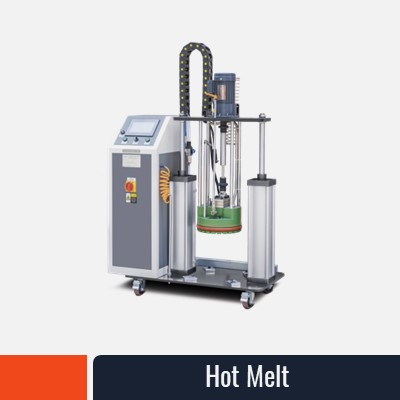
- Hot melt (thermoplastic, reversible)
The robot doesn't judge the material—it dispenses what you load into its system. This versatility makes adhesive dispensing robots ideal across industries because you can switch materials without replacing hardware.
How Adhesive Dispensing Robots Work
The process breaks into three synchronized operations:
1. Programming and Positioning The robot arm is programmed with exact coordinates for each adhesive application point. Using teach pendants or offline CAD-based programming, engineers define the path the nozzle must follow, the speed at which it moves, and the dwell time at each location. Modern systems support visual recognition and positioning—camera feedback allows the robot to self-correct if component placement varies slightly.
2. Flow Metering and Control A precision pump or valve meters adhesive in microliter increments. Pneumatic, electric, and positive-displacement systems each have strengths:
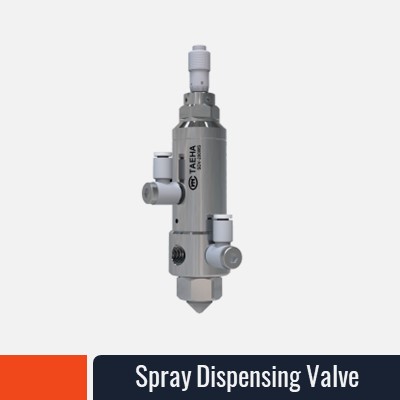
- Pneumatic valves (most common) respond quickly to pressure signals and cost less
- Electric metering pumps deliver tighter volume control and reduce material consumption
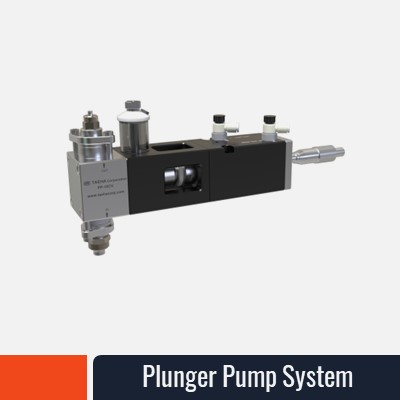
- Positive-displacement pumps handle high-viscosity adhesives and two-part formulas
Real-time pressure and volume sensors monitor flow and automatically adjust for material viscosity changes or temperature fluctuations. If flow strays outside tolerance, the system alerts the operator or pauses the cycle.
3. Dispensing and Cure As the arm moves, the valve opens and closes in timed pulses or continuous streams, creating dots, beads, or sprays. Once applied, the adhesive cures passively (at room temperature), with heat, or under UV light—depending on the adhesive chemistry. The robot tracks cure time and can queue the next assembly step only after adhesive reaches full strength.
This closed-loop control ensures every bond receives the same material volume, the same application pattern, and the same cure conditions. Variation typically drops well below what manual application achieves.
Types and Systems of Adhesive Dispensers
Adhesive dispensing robots come in several configurations, each optimized for different manufacturing environments:
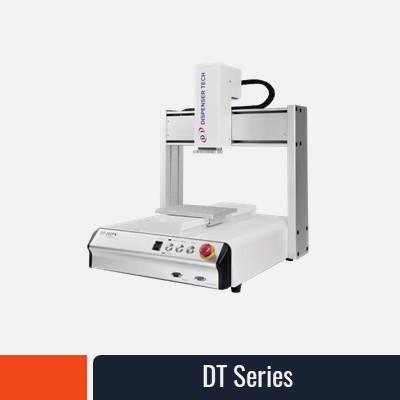
Cartesian (Gantry) Robots Linear motion along X, Y, Z axes. Ideal for flat PCBs, flat panels, and high-speed production lines. Lower cost, easy to integrate with conveyors. Limited to perpendicular surfaces.
6-Axis Articulated Robots Multi-joint arms with full spatial freedom. Handle complex 3D components, assemblies with undercuts, and curved surfaces. Higher precision and flexibility, but require more programming and floor space.
4-Axis and 5-Axis Systems Hybrid designs balancing cost and capability. Common in automotive and appliance manufacturing for medium-complexity assemblies.
Jet Dispensers (No-Contact) High-speed micro-jetting of adhesive without nozzle contact. Ideal for delicate components and rapid-dry formulas. Used heavily in electronics for underfill and conformal coating.
Pneumatic vs. Electric Systems
- Pneumatic: Fast response, lower upfront cost, suited for high-volume production and standard adhesives
- Electric: Precision in low-volume/high-mix environments, better material efficiency, compatible with pressure-sensitive and shear-thinning adhesives
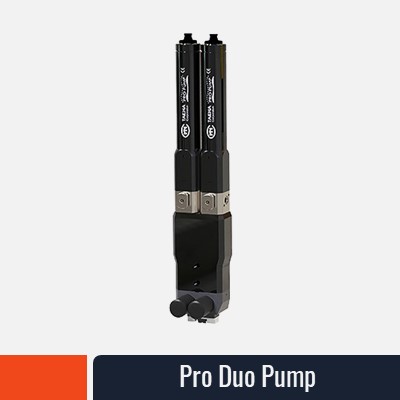
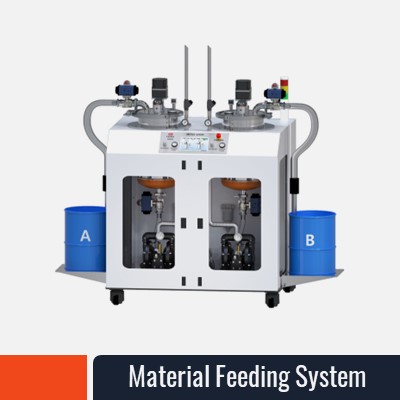
Meter-Mix Systems Two dispensing pumps deliver part A and part B of a two-component adhesive, mix them at the nozzle, and apply immediately. Essential for epoxy, polyurethane, and other reactive adhesives. Eliminates pre-mixed batches and extends material shelf life.
Key Applications and Industries
Electronics & PCB Assembly Adhesive dispensing robots are standard on SMT (surface-mount technology) lines. They apply underfill adhesive under flip-chip components, conformal coating on assembled boards, and structural adhesive for display bonding. Microvolume dispensing (nanoliter to microliter) prevents rework and improves yield on high-density boards.
Automotive & EV Manufacturing Robots seal battery pack edges with silicone and polyurethane to prevent electrolyte leakage. They bond trim panels, gaskets, sensors, and connectors—often with high-temperature adhesives that cure at 60–150°C. The consistency from robotic application meets automotive quality standards (AEC-Q200) without variance.
Medical Device Manufacturing Sterile environments and biocompatible materials demand precise, repeatable adhesive application. Robots apply adhesive to surgical instruments, diagnostic devices, and implant assemblies—with traceability and zero contamination. Hot melt and UV adhesives are favored for their rapid cure and compatibility with sensitive substrates.
Consumer Electronics & Appliances Robotic adhesive application speeds assembly of phone components, wearables, white goods, and industrial equipment. High-speed systems push cycle times to 3–5 seconds per unit, enabling 1,000+ units per shift.
Aerospace & Defense Aerospace-grade epoxy and structural adhesives require controlled application to meet as-7075 and MIL-spec standards. Robots provide auditability (every bond is logged) and eliminate human error on high-value assemblies.
How to Choose an Adhesive Dispensing Robot
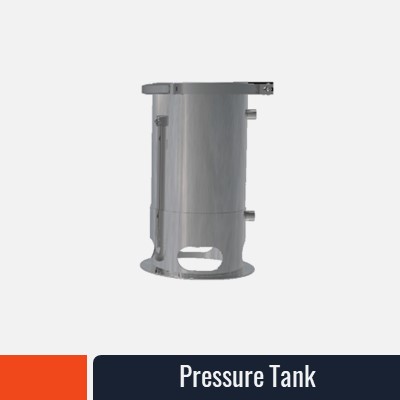
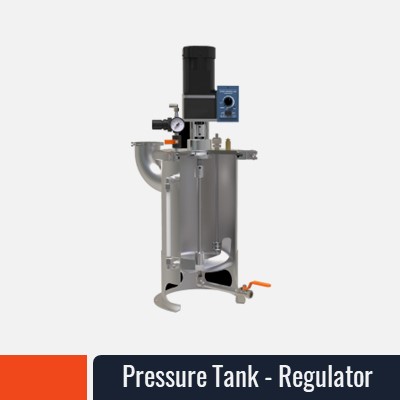
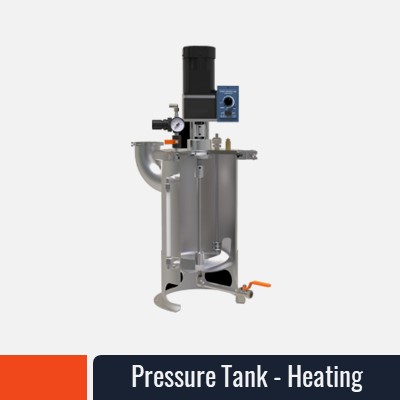
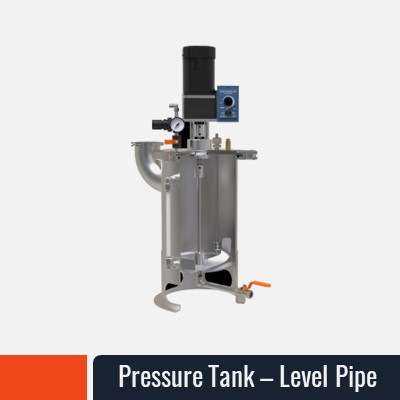
1. Define Your Material Adhesive chemistry drives hardware choice. Low-viscosity cyanoacrylate flows from a simple solenoid valve. High-viscosity epoxy needs a positive-displacement pump or heated pressure tank. Two-part adhesives demand meter-mix capability. Identify your adhesive first, then match the dispensing system.
2. Assess Your Geometry Can your components be reached by a Cartesian gantry, or do you need articulated motion? Flat PCBs benefit from linear systems. Complex 3D assemblies (steering columns, connectors, housings) require 5–6 axis robots. Budget and integration time increase with complexity.
3. Calculate Volume and Viscosity Small dots (< 1 mm³) favor jet dispensers and electric metering. Large beads (10+ mm³) use pneumatic pumps. Mid-range volumes (1–10 mm³) work with most systems. Viscosity (cP, centipoise) affects pump speed—higher viscosity needs more pressure, slower pumping.
4. Set Cycle Time and Throughput How fast does your line move? If cycle time is 5 seconds per unit, adhesive dispensing can take only 1–2 seconds. Jet and pneumatic systems excel here. Electric precision systems are slower but use less material.
5. Integration and Footprint Will the robot retrofit into an existing line or become a standalone cell? Do you have space for a 6-axis arm (8–10 feet) or need a compact Cartesian (4–6 feet)? Integration cost can rival or exceed hardware cost.
6. Budget for Reliability A $50k adhesive dispensing robot that runs 8 hours per shift, 300 days per year generates more ROI than a $200k system that fails weekly. Prioritize proven suppliers with local support, spare parts availability, and service response time under 24 hours.
Benefits of Adhesive Dispensing Automation
Precision and Consistency Manual application varies by operator mood, fatigue, and training. Robotic systems dispense the same volume, at the same angle, with the same timing, every single time. Bond strength variance typically shrinks, reducing rework and field failures.
Reduced Material Waste Robots use only the adhesive needed. Manual application often overfills to ensure coverage, wasting 20–30% of material. Automated metering saves material cost and shrinks assembly time (less cleanup, less overflow).
Faster Cycle Times Robots don't get tired. A pneumatic dispenser can apply a 100-dot pattern in under 2 seconds. Conveyor integration means parts move continuously—no waiting for adhesive to be hand-applied. Cycle time improvements of 30–50% are typical.
Worker Safety Epoxy, cyanoacrylate, and isocyanate adhesives are hazardous. Fumes, skin contact, and cumulative exposure cause respiratory and dermatological issues. Automating dispensing moves workers away from these hazards and into quality inspection and robot oversight—safer, more engaging roles.
Quality Assurance and Traceability Every bond is logged: timestamp, volume dispensed, pressure, nozzle position, operator ID. This traceability meets FDA, ISO 13849, and automotive audit requirements. Real-time monitoring catches process drift before it causes defects.
Scalability Adding a second shift or increasing production doesn't require hiring more adhesive technicians. The robot scales effort linearly with demand—one system handles 100 units or 10,000 units per month with the same labor footprint.
Adhesive Dispensing Robots vs. Manual Application
| Aspect | Manual Application | Automated Dispensing Robot |
|---|---|---|
| Consistency | Varies by operator and shift | Repeatable cycle to cycle |
| Cycle Time | 20–60 sec per unit | 2–10 sec per unit |
| Material Waste | 20–30% overfill | 2–5% waste |
| Worker Exposure | Direct (hazardous) | Minimal (automated) |
| Scalability | Labor-limited | Equipment-limited |
| Traceability | Manual logs (error-prone) | Automated (audit-ready) |
| Initial Cost | $0–10k (nozzles, training) | $50k–300k (system) |
| Payback Period | N/A | 6–18 months (typical) |
For production volumes above 500 units per month, the robot's payback depends on labor cost, scrap rate, and cycle time. We can walk through your numbers. Below that threshold, manual application may still be cost-effective.
Ready to Automate Your Adhesive Dispensing?
Switching from manual to robotic adhesive dispensing isn't just about speed—it's about consistency, safety, and survival in high-volume manufacturing. Whether you're applying epoxy to automotive structural components, UV adhesive to medical devices, or silicone sealant to EV battery packs, a dispensing robot handles the precision work so your team can focus on quality oversight and continuous improvement.
Our engineers at Dispense Robotics have configured adhesive dispensing systems for electronics, automotive, medical, and aerospace manufacturers. We know the material profiles, cycle times, and integration challenges of your industry.
Ready to explore options?
Contact our team to discuss your material, geometry, and production goals. We'll recommend the right system, provide cycle-time projections, and walk you through payback scenarios.
Call: +1 386-585-0355 Email: gavin@dispenserobotics.com
Or schedule a consultation with our engineering team to discuss custom dispensing solutions for your production environment.